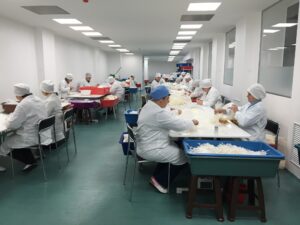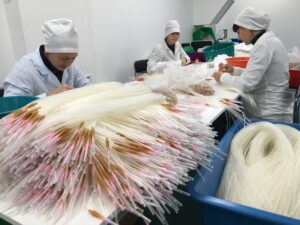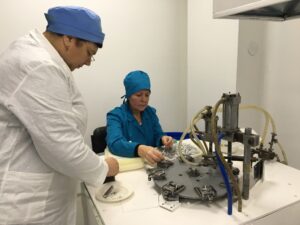
Currently, the production base of Medplast includes production facilities with a total area of more than 1000 sq.
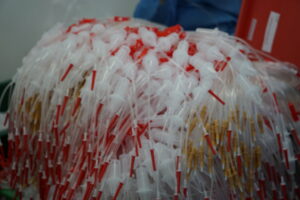
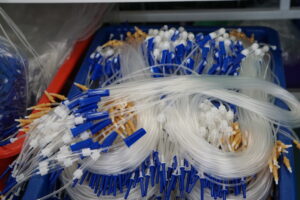
Warehouses for raw materials, components and materials occupy 270 sq. m.
To ensure production, the latest equipment from the best domestic and foreign companies was purchased. In our work, we use raw materials, materials and components from the world’s leading manufacturers.
The raw materials used for the production of systems and containers are stored in granular form in the warehouse. The warehouse carries out daily monitoring of temperature, humidity, in accordance with the quality management system. Further, the bags with raw materials are transported to the casting workshop, where they undergo temperature adaptation and sanitization.
The plastic molding shop (room of cleanliness class “D” – ISO 8) is equipped with modern injection molding machines. Among the equipment there are 6 injection molding machines, two extrusion lines, two vertical injection molding machines, a hydrosyringe press (GSHP). There are two crushing machines in the plastics recycling site.
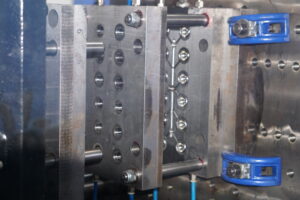
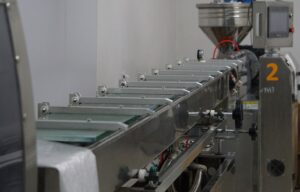
Granular raw materials are placed in the loading hopper of the injection molding machine, then it enters the material cylinder, in which the heaters and the screw are located, which makes rotational and translational movements. In the material cylinder, the raw material granules are heated and plasticized to a viscous-flowing state, after which the heated material is injected into the cooled mold, where it takes on the volume of the inner cavity of the mold. Then the material is cured to obtain complete shrinkage, the mold is opened and the parts are dumped into the interoperable container. In this container, the components are delivered to the warehouse of semi-finished products, and after 24 hours aging are transferred to the assembly shop.
After cooling, the component parts are delivered to the assembly shop – a room of cleanliness class “C” – ISO 7. The assembly shop has 70 seats for workers.
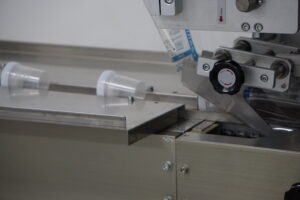
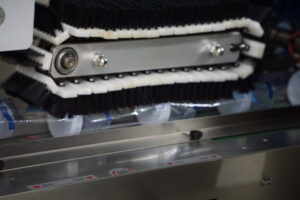
Preparation for packaging containers begins with unwinding and feeding the roll film.
During the packaging process, containers are automatically placed in polypropylene film that meets all quality standards. After sealing the package, the printer prints all the necessary data on the film (production date, expiration date, etc.).
After that, the products are placed in boxes with information already printed on them: date of manufacture, batch number, expiration date, etc.
The inner boxes are placed in transport boxes, which also contain all the necessary data, and then they are transported to the sterilization area.